3. Results
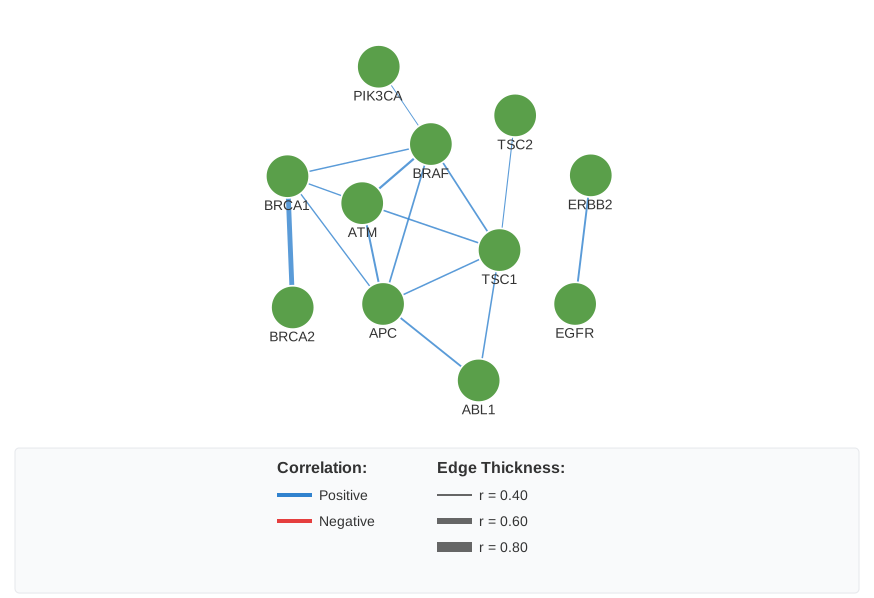
Double-click node for Expression, edge for Correlation
New to CoExpress?
Click Test Genes and then Run ▶
(both in "2. Input Genes")
Next, double-click nodes and edges in the generated network for more functions. Decrease correlation cutoff and press Run again to identify interactions of weaker strength.
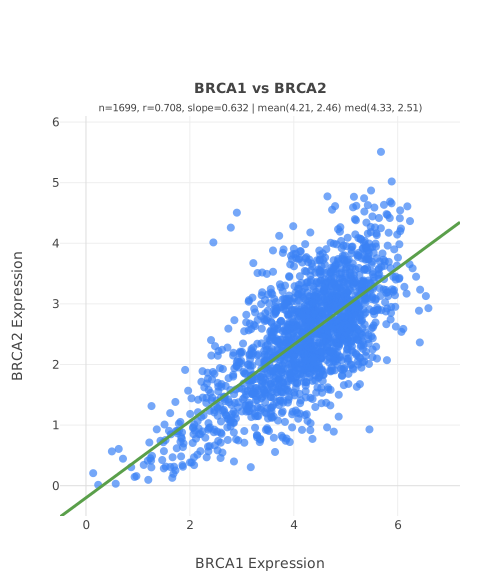
Tip: Click Correlate to view a scatter plot, or By Tissue for tissue breakdown. Ctrl/Cmd+click a column header to copy that column. Use Filters to set numeric cutoffs on columns.
| Gene1 | Gene2 | Correlation | Slope | N | Cluster | Analyze |
|---|---|---|---|---|---|---|
| Run analysis to view correlations | ||||||
Mean (All) = all cells, Mean (Filt) = filtered cells. * indicates genes from your input list (Design mode). All input genes are shown; "Corr" column indicates if correlations were found.
| Gene | Cluster | Mean Effect | SD |
|---|---|---|---|
| Run analysis to view clusters | |||
Note: Differential expression may reflect selection bias (e.g., mutations enriched in certain cancer types) rather than direct functional consequences of the mutation. Consider filtering by lineage to control for tissue-specific effects.
Statistics: p-values are calculated using Welch's t-test comparing expression scores between wild-type (WT, 0 mutations) and mutated cells (1+2 or 2 mutations). Δ Expr = Mean(mutated) − Mean(WT).
0 genes with p < 0.001
| Gene | N (WT) | Mean Expr (WT) | N (1+2) | Mean Expr (1+2) | Δ Expr ▲ | p-value | N (2) | Mean Expr (2) | Δ Expr (2v0) | p-value (2v0) |
|---|
Low Risk: Exact synonyms from HGNC. Mid Risk: Less certain synonyms. Orthologs: Mouse-to-human gene mappings.
| Input Gene | Status | Official Symbol | Low Risk Synonyms | Mid Risk Synonyms | Orthologs (Mouse→Human) |
|---|---|---|---|---|---|
| Select "Synonym/Ortholog Lookup" mode and click Run | |||||
Run analysis to view summary